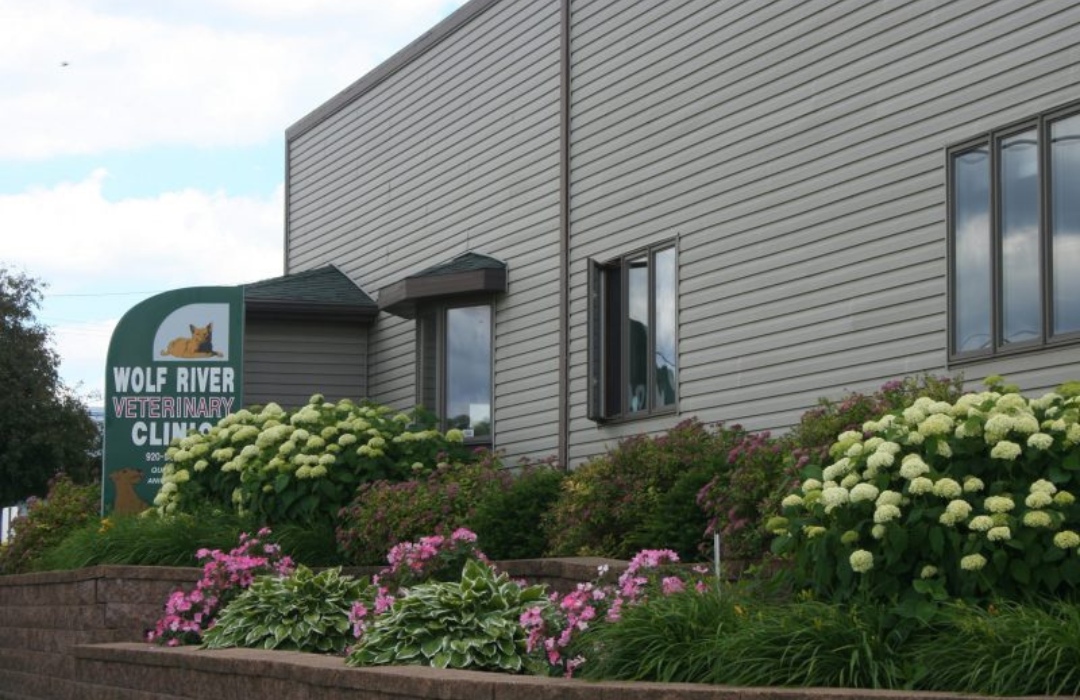
WOLF RIVER VETERINARY CLINIC
216 W. Wolf River Ave
New London, WI  54961
Phone 920-982-2733 - fax
920-982-3112

Home Our Staff  Newsletter Articles
Wolf River Vet  Services Pets for Adoption-Stray Animal Fund Contact Us

WRVC NEWSLETTER
Summer 2008


INSIDE THIS ISSUE:

bullet WRVC Position On Puppy Mill Legislation
bullet WRVC goes (partially) digital
bullet What's up with Cat Care?
bullet New WRVC Staff Members
bullet Food & Fuel - The one two Punch
bullet Product Review - Proheart®
bullet S.A.F.E.
bullet Archives


WRVC Position on Puppy Mill Legislation

Every veterinary clinic works with breeders.  Quite honestly, some are better than others.  This has made for controversy with Wisconsin's recent attempt to pass a “puppy mill” and “lemon law” bill for virtually all puppies sold.  While the original bill has failed to gain any acceptance, the topic will certainly be readdressed in the near future with a revised bill.

It seems that virtually all breeders were intimidated by the proposed legislation.    The wording made even the good breeders worry about the logistics of continuing to breed, as it seemed to favor the buyer and threaten the breeder with stiff penalties if a puppy had any sort of problem during the first year of life.  Selfishly, the bill was unfair to veterinarians, too, as it essentially put us in the middle of a no win situation.  All of this has left many clients wonder where we truly stand on the issue of puppy mills and breeding.


I can clarify this easily in saying we oppose the breeding of any animals for the sole purpose of profit, without taking into consideration the well-being of not only the adult breeding animals, but also the future generations of pets that will follow.  Breeding must be done for the purpose of the love and the betterment of the breed,  and there must be an intense concern for the well being of all of the animals involved in a breeding program.  These same attributes must also apply to those who intentionally  breed “designer” or mixed breeds of a specific combination. 

 There does need to be legislation that will bring an end to puppy mills.  The buyer does need to be protected, and there needs to be stiff ramifications for those not doing a good job of breeding.    When such a law is written, however, it also needs to be fair to the good breeders, and also to the veterinarians,  who will be intricately linked to the whole process.  There have been proposals on the table to achieve this,  but only time will tell whether they will gain any acceptance


         WRVC Goes (partially) Digital

Special points of Interest:

-
Breeding must be done for the love & betterment of the breed

-Hill's Pet Food Company Informed us Prices will be raised 12-13%

-Digital x-ray has greatly improved our service


One of our clinic goals for 2008 is to go to digital x-rays for all of our radiographic services.  The clinic recently acquired a digital dental x-ray system, which has greatly improved our ability to obtain quality, detailed x-rays of not only individual teeth, but also to do whole mouth x-rays easily at a reasonable cost.  The potential for this is to improve our services is remarkable.  We are already wondering how we got along without this tool for so long.

 Currently, we are also shopping for a system for all of our x-rays to go digital.  These systems are expensive, and they all  have their pros and cons;  The selection of the right system for the clinic will take some time, but when we do go digital, the benefits will be amazing.  This upgrade is an area we are very excited about, and it is part of our commitment to providing better service to our clients and their pets. 


What's up with Cat care?

"Statistics have confirmed that fewer people are taking their cats in for veterinary care."


  In a day when veterinary medicine has advanced to offer the best possible health care for pets ever, a disturbing trend has become apparent-the number of times a pet cat visits the veterinarian is on the decline.  Statistics have confirmed that fewer people are taking their cats for veterinary care, and those that are doing so are going less frequently.

The reasons for this are many-and one of them is not the need for veterinary care.  The change to every three year vaccination protocols has led many owners to believe that they do not have to do anything in the “off” years.  Many clients do not mind paying for vaccinations, but they do not see the value in an annual physical exam, or paying for blood testing that monitors important internal organ function as a pet gets older.  Even fewer see the need for dental care as a pets oral health deteriorates.  This is compounded by the fact that cats are very stoic animals and to look at them is to, in general, see contentment.  Cats are tricky, though, and a sick one can look as normal as a healthy one.

Perhaps the veterinary profession is to blame for a lot of this.    Admittedly, we have relied on vaccinations for far to long to get clients in the door.  It is up to us to teach cat owners the value of other proper forms of care.  Truth be told, the most important thing we can do is to educate our clients about what constitutes a good health care program.  While our profession is worried about the current trends in cat care, it is also going to be up to us to reverse this trend.  Time will tell how well we can accomplish this.


WRVC Introduces New Staff Members

There are new faces at WRVC that we would like to introduce.  The clinic recently hired Ashley Schwartz, a licensed certified veterinary technician with additional certification in veterinary dentistry.  Ashley recently moved to the area after working in the Twin Cities.  Thus far, she has been a wonderful asset to the clinic, and is currently helping upgrade many of our services and procedures.

The clinic also hired Carrie Meidam, a local (Manawa raised)  who recently graduated form the Horizon program for veterinary assistants. Carrie is an intelligent, outgoing person with a passion for working with people and pets.  Her energy seems unlimited, and she has already added a spark to the clinic.

We are proud to have these two new employees as part of our team.  We encourage all of our clients to welcome them to our practice.


Food and Fuel-The one-two Punch!


A person cannot get into a conversation these days without talking about the soaring energy cost and food prices.  Not only is the price of oil out of control, but our illusion that we can use food for fuel has added insult to injury in the rising price of food.  Dog and cat food are not exempt.  The Hills pet food Co. recently informed us that prices will be raised 12-13% across the board immediately.  It is  certain that other food companies will soon follow suit. Good quality pet foods seem to be expensive enough, and now they are going up in cost even more.  What is a consumer to do?

Here are a few tips from my point of view.  First, feed a good quality diet.  The extra you pay is worth it.  Junk food is junk food-inexpensive does not make it good.  Second, do not overfeed your pet.  It is estimated that 40% of pets are overweight.  Excess body fat starts out as excess food you paid for, and it won’t make your pet healthier.

 Third, buy in bulk.  Clinics need to move inventory too.  We have given discount for larger “stock up” purchases in the past.  Most foods will store for a long time if properly cared for.

Fourth, some brands offer coupons and frequent buyer incentives.  The Nurto company, for one, has a number of nice programs that can help consumers keep the price down.

Lastly, cut back on what you don’t need.  Many people spend money on inappropriate treats and toys that a pet doesn’t need or benefit from.  The money spent on  these items can certainly be directed to something better.

Cost are going up-it is inevitable.  Continuing to offer your pet proper nutrition does not have to be an obstacle, however.  It’s like anything else-with a little planning, anything can work.


New (old) Product Review- Proheart®

Some clients may remember the injectable product Proheart® for heartworm control.  It was a six month repositoritory injection for the prevention of heartworm disease in dogs.  The concept was simple– one injection virtually replaced the need for any other heartworm preventatives.  In Wisconsin, a well timed injection of this product could suffice as the years heartworm control program.

The product had a couple of short comings.  One was that,  unlike the oral products, it had no effect on intestinal parasites, which is a nice advantage with Heartguard, Interceptor, and Iverheart.  Second, the product was voluntary recalled by Fort Dodge due to the F.D.A. recording a higher than normal incidence of injection site reactions.  At the time, it seemed like the product was dead in the water.

This is not so, however, as Proheart® will be reintroduced shortly.  For Wisconsin dogs and their owners, the timing of this is poor given that most owners already have their heartworm prevention products in line for the year.  Assuming that the product stays around this time, it may play a role for prevention in 2009.  Time will tell whether Proheart® will become a major player in the heartworm prevention market.  For now, it is simply a time to sit back and observe.


S.A.F.E.

S.A.F.E. (Stray Animal Fund Endeavor) is a program within the Wolf River Veterinary clinic which cares for the areas stray cats and dogs.  The clinic provides safe, comfortable housing for strays until they are either claimed by their owners, or, if unclaimed, placed into our adoption program.  Adopted pets are spayed, neutered, vaccinated, checked for any potential health problems, and their personalities are assessed prior to their placement in a new home.  It is the goal of S.A.F.E. to do the best we can to give every life a chance.  (See Pets for Adoption page)


Home Our Staff  Newsletter Articles
Wolf River Vet  Services Pets for Adoption-Stray Animal Fund Contact Us